
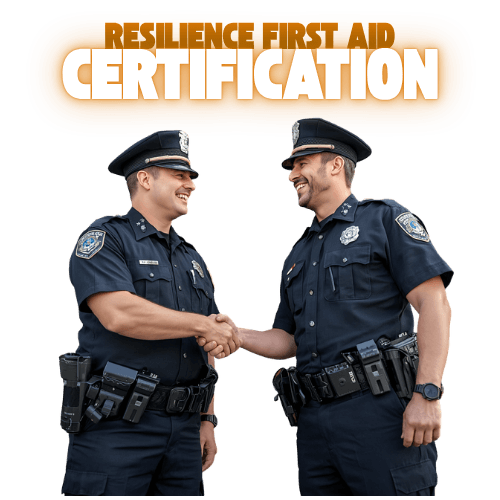
RESILIENCE FIRST AID CERTIFICATION
Stop Being a Bystander. Start Being the Officer Who Can Help.
RFA gives you the ALL Protocol — tactical peer-support skills to recognize warning signs early, have conversations that actually help, and connect officers to resources before they reach crisis. Not therapy. Not counseling. Skills you can use on your next shift.
SELF PACED CERTIFICATION | 16 - 20 Hours | $497
Not sure yet? Take the free Resilience Assessment first.
178
Critical incidents the average officer works over a career
85%
The protective resilience threshold, most officers never reach it
1 in 10
Officers who hit the protective threshold without training
92.9%
Of US officers currently below the protective threshold
You Noticed. But, Didn't Know What to Do.
Your partner's been off for weeks. Withdrawn. Irritable. Not himself. You want to help, but what do you say? How do you start that conversation without making it weird or making it worse?
So you wait. Hope he snaps out of it. Tell yourself he'd reach out if he needed something.
Meanwhile, he keeps showing up looking worse.
85% of officer suicides showed warning signs that other officers noticed but didn't know how to address.
That's the Bystander Gap. The distance between noticing a peer is struggling and actually knowing how to help. It's not indifference. It's the absence of training.
You default to "he seems fine," or you avoid it entirely because you're afraid of saying the wrong thing. Your department offers EAP, but nobody ever showed you how to connect a struggling officer to those resources without it feeling like you're filing a report on him.
You're stuck between doing nothing and doing the wrong thing. So you do nothing.
And that eats at you.
THE BYSTANDER GAP
This is not a character flaw. It's a training gap.
Three Problems. One Gap.
YOU SEE THE SIGNS
Missing workouts. Showing up late. Snapping at the squad. Withdrawn from the crew. The shift goes quiet around him. You've been watching it for months.
But you've got no training on how to start that conversation. Nobody taught you peer-support skills at the academy. You default to waiting.
YOU FEEL THE GUILT
You feel it every time an officer spirals, and you wonder if you should've said something earlier. You want to do something. But you're not a therapist, and you don't want to fumble through a conversation that makes things worse.
So you default to nothing. And the guilt compounds with every shift.
THE DOUBLE STANDARD
Officers protect each other on the street without hesitation. But when the threat is psychological — cumulative trauma, the stuff that actually kills more cops than line-of-duty incidents — we stand by and watch it happen.
Not because we don't care. Because nobody ever gave us the skills to intervene.
We've Been There. We Know What It Costs to Do Nothing.
You've noticed peers struggling and didn't know what to do. You've watched officers spiral and wondered if you should've said something earlier. You wanted to help, but nobody ever taught you how to have those conversations without making things worse.
You don't need suggestions to "check in more" or "be supportive." You need to know exactly what to say, when to say it, and when peer support isn't enough.
That's what RFA is built to give you.
PR6 Model
Peer-reviewed evidence-based training across all six resilience domains
Built for Law Enforcement
Not general wellness training — designed for shift work and critical incident exposure
Proven Training
Skilled outcomes that work when applied to everyday life.
Evidence Based
33% improvement in recognizing suicide warning signs.
What You're Learning
Resilience First Aid is peer-reviewed, evidence-based training built specifically for law enforcement. This is tactical peer-support training.
CORE FRAMEWORK
The ALL Protocol
A tactical framework for peer support conversations — the three moves that take you from noticing someone is struggling to actually doing something about it. You'll learn how to appreciate what they're experiencing without minimizing it, listen without redirecting to your own story, and lift by connecting them to the right resources at the right time.
This works at levels 4–7 on the struggle scale, when peer support can actually change the trajectory. At levels 8–10, you'll know it's time for professional help — and you'll know how to get them there.
SITUATIONAL AWARENESS
The PR6 Resilience Model
Six domains. One framework for reading your peers.
Composure. Collaboration. Vision. Reasoning. Health. Tenacity. Officers who maintain 85% or higher across these six domains are protected from operational stress injuries. Most officers hover around 65–70% — functional, but vulnerable.
RFA teaches you what a drop in each domain looks like behaviorally — what you actually see on shift when someone's Collaboration is failing or their Tenacity is gone. Not clinical definitions. Operational patterns you can recognize in the field.
MEASURED OUTCOMES
Evidence-Based Results
These aren't guesses. They're measured.
Officers completing RFA training show: 33% improvement in recognizing suicide warning signs 17% improvement in stress response control 14% improvement in personal resilience
The training is accredited by Suicide Prevention Australia and AACME for mental health continuing education. That means POST-equivalent hours your department can count. Not just a certificate. Documented professional development.

1. Learn the Model
Master the PR6 domains and understand what 85% protective resilience actually looks like—in yourself and in your peers.
Module Coverage:
What resilience means for law enforcement (not corporate wellness BS)
The six domains that predict who makes it to 25 years intact
Why most officers hover at 65-70% (functional but vulnerable)
The 85% protective threshold and how to maintain it
Neuroscience behind why this training works

2. Practice the Protocol
Get hands-on training with the ALL Protocol through real scenarios—know what to say, when to say it, and when to escalate.
Skills Training:
Recognizing warning signs across all six PR6 domains
Starting conversations without judgment or making it weird
Using the ALL Protocol (Appreciate, Listen, Lift)
Understanding levels 4-7 (peer support territory) vs. 8-10 (professional help needed)
Connecting officers to resources effectively
Maintaining your own resilience while supporting others
3. Build Your Skills
Complete the 16-20 hour self-paced certification, pass the assessments, and earn your Resilience First Aid credential.
Course Includes:
10 comprehensive modules
9+ hours of video training
Real-world scenario practice
Domain-specific assessments
Personal resilience worksheets
30/60/90-day implementation plan
Final certification assessment
Format: Self-paced online.
What This Is Not
You're not learning to be a therapist. You're learning to be an effective peer.
RFA doesn't turn you into a counselor, a crisis worker, or a mental health professional. It gives you the skills to notice warning signs early, have conversations that help rather than make things worse, and connect officers with the right resources when peer support isn't enough.
This is prevention work, not crisis response. You're building resilience capacity before trauma overwhelms it — not waiting for the crash and then trying to clean it up afterward.
Peer support shouldn't be something you figure out alone or avoid because you might screw it up. That's what the Bystander Gap feeds on.
What Happens If Nothing Changes
You keep noticing peers struggle and doing nothing about it. The guilt stacks up every time an officer spirals, and you wonder if you should've said something earlier. You watch warning signs but don't know how to address them. When someone finally crashes, you're left wondering what you could've done differently — but nobody ever gave you the tools to do it.
Your own resilience keeps draining year by year. The 178 critical incidents compound. You're hovering around 65% — functional but vulnerable. One bad call away from dropping below 50%, where peer support isn't enough anymore.
And when that happens, there's no one equipped to help you either.
The Bystander Gap doesn't just cost other officers. It costs you.
What Changes When You're Trained
You recognize warning signs early — not six months after someone's been struggling. You know how to start a conversation that helps rather than makes things worse. You've got the ALL Protocol to guide you through peer-support situations you used to avoid.
When officers are at levels 4–7 on the struggle scale, you can actually do something about it. When they're at 8–10, you know it's time for professional help — and you know how to connect them to resources without it feeling like you're turning on them.
You maintain your own 85% protective threshold because you understand the six domains and how to build them proactively. You process critical incidents within days instead of carrying them for months.
You finish your career intact and help other officers do the same. Not by accident. Because you have the training.
You become the officer that peers come to when they're struggling. Not because you're a therapist. Because you've got the skills and you've carried what they're carrying. That's the difference.
Everything That's Included
INVESTMENT
$497
-90-Day Access to All Modules
-9+ Hours of Video Instruction
-Downloadable Worksheets
-Domain-Specific Knowledge Checks
-Real-World Scenario Practice
-Personal Resilience Planning Tools
-Final Certification Assessment
TIME COMMITMENT
16-20 Hrs
-Complete around your schedule
-No live sessions required
-90-Day access window
-Available 24/7
-Designed for shift work
-Progress saved automatically
-Real-world practice
REQUIREMENTS
LE Only
-Active or retired law enforcement
-Complete all modules
-Pass assessments
-Complete 30/60/90 Day Plan
-Application required
-Approved within 24 hours
-Complete all habits and tasks
Resilience First Aid Certification
What Happens if Nothing Changes?
You keep noticing peers struggle and doing nothing about it. The guilt stacks up every time an officer spirals, and you wonder if you should've said something earlier.
You watch warning signs but don't know how to address them. When someone finally crashes, you're left wondering what you could've done differently—but nobody ever gave you the tools to do it.
Your own resilience keeps draining year by year. The 178 critical incidents compound. You're hovering around 65% resilience—functional but vulnerable. One bad call away from dropping below 50%, where peer support isn't enough anymore.
And when that happens, there's no one equipped to help you either.
What Changes With Training?
You recognize warning signs early—not six months after someone's been struggling. You know how to initiate conversations that help rather than make things worse.
You've got the ALL Protocol to guide you through peer support situations you used to avoid. When officers are at level 4-7 on the struggle scale, you can actually do something about it. When they're at 8-10, you know it's time for professional help and how to connect them with resources.
You maintain your own 85% protective threshold because you understand the six domains and how to proactively build them. You process critical incidents within days rather than carry them for months.
You finish your career intact and help other officers do the same. Not by accident—by design.
You become the officer that peers come to when they're struggling. Not because you're a therapist. Because you've got the skills and you've carried what they're carrying.
That's the difference RFA training makes.
What You'll Be Able to Do
After completing RFA Certification, here's what changes:
You recognize the signs when peers are struggling—behavioral changes, withdrawal, performance shifts—and you know what they mean
You have conversations using the ALL Protocol that actually help—you Appreciate the situation, Listen without fixing, and Lift by connecting them to resources
You maintain your own 85% resilience threshold across all six PR6 domains—Composure, Collaboration, Vision, Reasoning, Health, Tenacity
You know the difference between peer support territory (level 4-7) and when professional help is needed (level 8-10)—and you're not afraid to make that call
You process critical incidents proactively instead of letting them compound over months and years
Officers come to you when they're struggling because word gets around that you've got the skills and you don't make it weird
You've got language for resilience that doesn't sound like corporate wellness or therapy-speak—tactical terms officers actually use
You're certified in evidence-based peer support that's recognized by Suicide Prevention Australia and AACME for mental health continuing education
You prevent crises instead of responding to them—building protective resilience before trauma overwhelms capacity
You finish your career intact and equipped to help the next generation of officers do the same—not by luck, but because you've got the training
Course Details
Investment: $497
What's Included
90-Day Access to All Modules
9+ Hours of Expert Video Instruction
Downloadable Worksheets
Assessments & Final Exam
Real World Scenarios
Personal Resilience Planning Tools
Time Commitment
16-20 Hours, Self-Paced
Complete Around Your Schedule
Reasonable Completion Time
90-Day Access to All Modules
Access to Material 24/7
Requirements
Active or Retired Law Enforcement
Commitment to Complete All Modules
Pass Assessments at 80% Minimum
Create 30-Day Implementation Plan
Create 60-Day Implementation Plan
Create 90-Day Implementation Plan
Stop Being a Bystander. Become an Officer Who Can Help.
You've been watching long enough. You know your peers need support. You know the warning signs are there. You know the current approach isn't working.
The only thing missing is the training to do something about it.
15-20 hours. $497. Skills that last a career.
Resilience First Aid gives you the ALL Protocol, the PR6 model, and the confidence to have peer support conversations that actually help. Not theory. Not suggestions. Tactical skills you can use on your next shift.
Officers who complete this training report 33% improvement in recognizing suicide warning signs. That's not just a statistic—that's potentially saving lives.
Not Ready to Enroll?
→ Click Here to Listen to the Police Speak Podcast - Hear how other officers use these tools in real situations.
→ Click Here to Get the FREE Critical Incident Recovery Protocol - The tactical protocol that helps you recover from trauma caused by critical incidents.
→ Click Here to Join the Police Speak Community - Connect with other officers and their families for ongoing support ($39/month)
© 2026 Police Speak
All rights reserved
Large Call to Action Headline
Large Call to Action Headline

Resilience First Aid Certification Application
This certification is available exclusively to sworn law enforcement officers and authorized first-responder peer-support professionals. Complete the application below to verify your eligibility.
RFA Certification teaches you tactical peer-support skills that help keep your peers intact during critical incidents. This is law-enforcement-sensitive training; the scenarios, protocols, and techniques are designed for the realities of police work. We verify every applicant to protect the integrity of this content and the safety of the officers who use it.
Application review: Most applications are approved within 24 hours. You'll receive an email with payment instructions once your payment is approved.
Questions? Email info@policespeak.org
We HATE spam. Your email address is 100% secure